Kia Syros EV
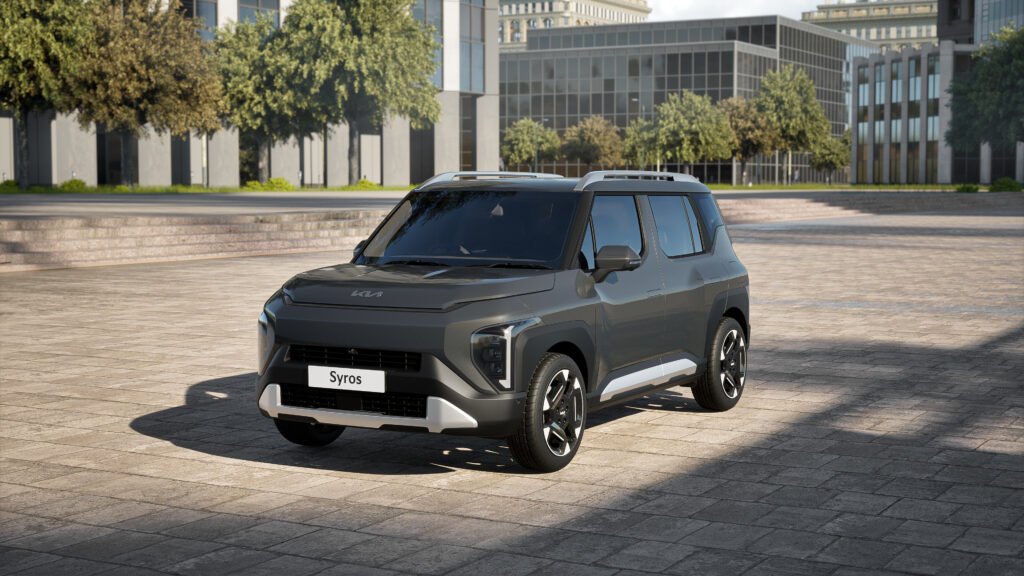
Kia’s Syros EV enters the crowded compact electric SUV segment with a straightforward pitch: the longest certified range and the fastest charging in its class, wrapped in a heavily tech-loaded cabin. Prices start at ₹13,49,900 and run across seven trims, up to the range-topping X-Line ER. This review looks at what Kia is actually offering, and — more importantly — who it makes sense for.
Quick Verdict
A genuinely well-specified electric SUV on paper — strong range, fast charging, and a long battery warranty that removes a lot of the usual EV anxiety. It’s a strong pick for tech-focused, city-based buyers, though this review is based on Kia’s official specifications and has not yet been verified on a real-world test drive.
Price & Variants
| Variant | Battery Pack | Ex-Showroom Price |
|---|---|---|
| HTK | 42 kWh | ₹13.49 Lakh |
| HTX+ ER | 51.4 kWh | ₹16.99 Lakh |
| X-Line ER | 51.4 kWh | ₹19.99 Lakh |
The Syros EV is offered across seven trims spanning two battery packs — a 42kWh unit good for a claimed 443km range, and a larger 51.4kWh Extended Range pack that pushes the certified figure up to 526km. Kia also offers a Battery-as-a-Service plan, unbundling the battery to bring the effective starting price down to around ₹7.99 lakh, with the battery billed separately on a per-kilometre basis.
Best Value Pick
The HTK+ is the sensible starting point rather than the base HTK. The entry trim is tempting on price, but it skips the rear camera and cruise control — features most buyers will expect as standard in 2026. Stepping up to HTK+ adds those essentials along with faster 100W charging, without committing to the larger, pricier 51.4kWh battery. The Extended Range packs are worth it only if the extra real-world range genuinely matters for your daily driving.
Exterior Design

The Syros EV wears Kia’s “Digital Tiger Face” front end, paired with Ice Cube MFR LED headlamps and Star Map-pattern LED daytime running lights, giving it a distinctly futuristic look rather than a re-skinned combustion model. Around back, Starmap LED combination tail lamps, an integrated spoiler, and a shark-fin antenna carry the theme through. Details like flush-mounted “Auto Streamline” door handles, glossy black roof rails, and puddle lamps that project the Kia logo onto the ground add a level of visual polish Kia is clearly positioning above segment norms. Wheel sizes range from 16-inch on base trims up to 17-inch crystal-cut dual-tone alloys on higher variants.
Interior Design

Inside, the cabin is built around a 30-inch (76.2cm) Trinity panoramic display spanning instrument cluster, infotainment, and climate readouts into a single glass panel — a segment-first at this price point, per Kia. A floating centre console with a sliding cover, retractable cup holders, and open storage keeps the cabin looking clean. Higher trims add a dual-pane panoramic sunroof and 64-colour ambient lighting with LED footwell lamps (X-Line only). Kia claims best-in-segment second-row space, with a 60:40 split rear bench that slides and reclines, plus a 465-litre boot — usefully large for the class.
Features

The feature list is dense for the segment: an 8-speaker Harman Kardon sound system, wireless phone charging, ventilated front and rear seats, a 4-way power driver’s seat, and a dual-camera dashcam with mobile app access. Connectivity runs through Kia Connect 2.0, offering over 95 features including OTA software updates, remote window control, scheduled charging, remote battery conditioning, multilingual voice commands, and smartwatch access. Digital Key — letting you lock, unlock, and start the car from your phone — is reserved for the top X-Line trim.
Safety kit includes 6 airbags, a 360-degree camera, electronic stability control, and hill-start assist as standard. Full ADAS Level 2 with 16 autonomous features is available too, though it’s worth flagging clearly: it’s exclusive to the range-topping X-Line ER trim, not the lineup generally — we cover exactly what’s included, and what’s gated to which trim, in the Tech & Safety Deep-Dive below.
Elsewhere, ambient touches carry over from the wider Syros range too — 64-colour ambient mood lighting, a Harman Kardon 8-speaker system, and a fully automatic climate control panel on a dedicated 5-inch touchscreen.
Performance

| Specification | Detail |
|---|---|
| Power Output | 171 PS |
| Certified Range | 526 km (ARAI MIDC-Full) |
| DC Fast Charging | 10%–80% in ~39 min (100kW charger) |
| AC Charging | 11 kW |
| Gear Selector | Shift-by-Wire, column-type |
| Regen Control | Steering-mounted paddle shifters, i-Pedal mode |
| Battery Warranty | Lifetime HV battery warranty — 15 years, unlimited km (first owner) |
On paper, the 171 PS output and 526 km range are both class-leading figures Kia is happy to lead with, and the 39-minute fast-charge time (10–80%) would make road trips considerably less stressful than most EVs in this price bracket. The lifetime high-voltage battery warranty is also a meaningful ownership reassurance, addressing one of the biggest hesitations first-time EV buyers have.
Tech & Safety Deep-Dive

The 30-inch (76.2cm) Trinity Panoramic Display is the centrepiece of the cabin, and Kia backs it with Kia Connect 2.0 — a connected suite Kia lists at 95+ features, covering remote window control, a “find my car” locator, multilingual voice commands, smartwatch access, over-the-air software updates, scheduled charging, and remote battery conditioning. Digital Key — using your phone to lock, unlock, and start the car — is real, but it’s gated to the range-topping X-Line ER trim only, not the lineup at large, so don’t assume it’s included if you’re looking at a mid-spec variant.
Driver-assistance is the same story: full ADAS Level 2 with 16 autonomous features (front collision-avoidance, smart cruise control with stop-and-go, lane keep assist, high-beam assist, driver attention warning, and a blind-view monitor built into the cluster) is exclusive to the X-Line ER — the only trim in the seven-variant range that gets it. Every other trim, including the mid-spec ER variants, misses out on ADAS entirely. Standard safety across the rest of the range is still solid for the segment: 6 airbags, a 360-degree camera, electronic stability control, hill-start assist, and a dual-camera dashcam with mobile app access.
Where the Syros EV tries to earn its keep is ownership confidence rather than just cabin tech. Kia backs the high-voltage battery with a lifetime warranty — specifically 15 years, unlimited kilometres, for the first owner — and pairs it with an Assured Buyback programme guaranteeing up to 70% resale value at the three-year mark, plus a 10% introductory top-up. There’s also a Battery-as-a-Service option that lowers the entry price to around ₹7.99 lakh by separating out the battery cost. All of it routes through K-Charge, Kia’s charging network claiming 20,000+ access points across India, managed from the same Connect app. It’s a genuinely well-thought-out ownership package on paper — the kind of detail that matters more day-to-day than 0-100 times.
How We Scored This
Following our Review Methodology, we rate every review across five criteria, then average them into the final Octane Score.
| Criteria | Score |
|---|---|
| Performance & Engineering | 9.0 / 10 |
| Practicality | 8.0 / 10 |
| Features & Technology | 9.5 / 10 |
| Safety | 7.5 / 10 |
| Value for Money | 8.0 / 10 |
| Octane Score (average) | 8.4 / 10 |
Verdict
The Syros EV’s specification sheet is genuinely competitive — range, charging speed, and warranty coverage all lead or match the best in its class, and the feature list punches well above what most buyers would expect at this price. Kia is clearly trying to remove every common objection to buying an EV in one product. Whether it delivers on ride comfort and everyday usability the way the spec sheet promises is the one thing left to confirm on the road.
Who Should Buy This
- First-time EV buyers who want the reassurance of a lifetime battery warranty and buyback programme
- City-based drivers who want the segment’s fastest charging for occasional longer trips
- Tech-focused buyers who’ll actually use a large display and a deep connected-app feature set
- Buyers with reliable home or workplace charging access
Who Should Avoid This
- Buyers who want proven long-term reliability data — this is a new-generation model without a track record yet
- Anyone without consistent access to charging at home or work
- Buyers who prioritize driving dynamics and outright performance over range and practicality
- Budget-focused buyers — pricing sits closer to premium compact SUVs than entry-level EVs
Disclosure: This article may contain affiliate links. We may earn a commission if you make a purchase through them, at no extra cost to you.